

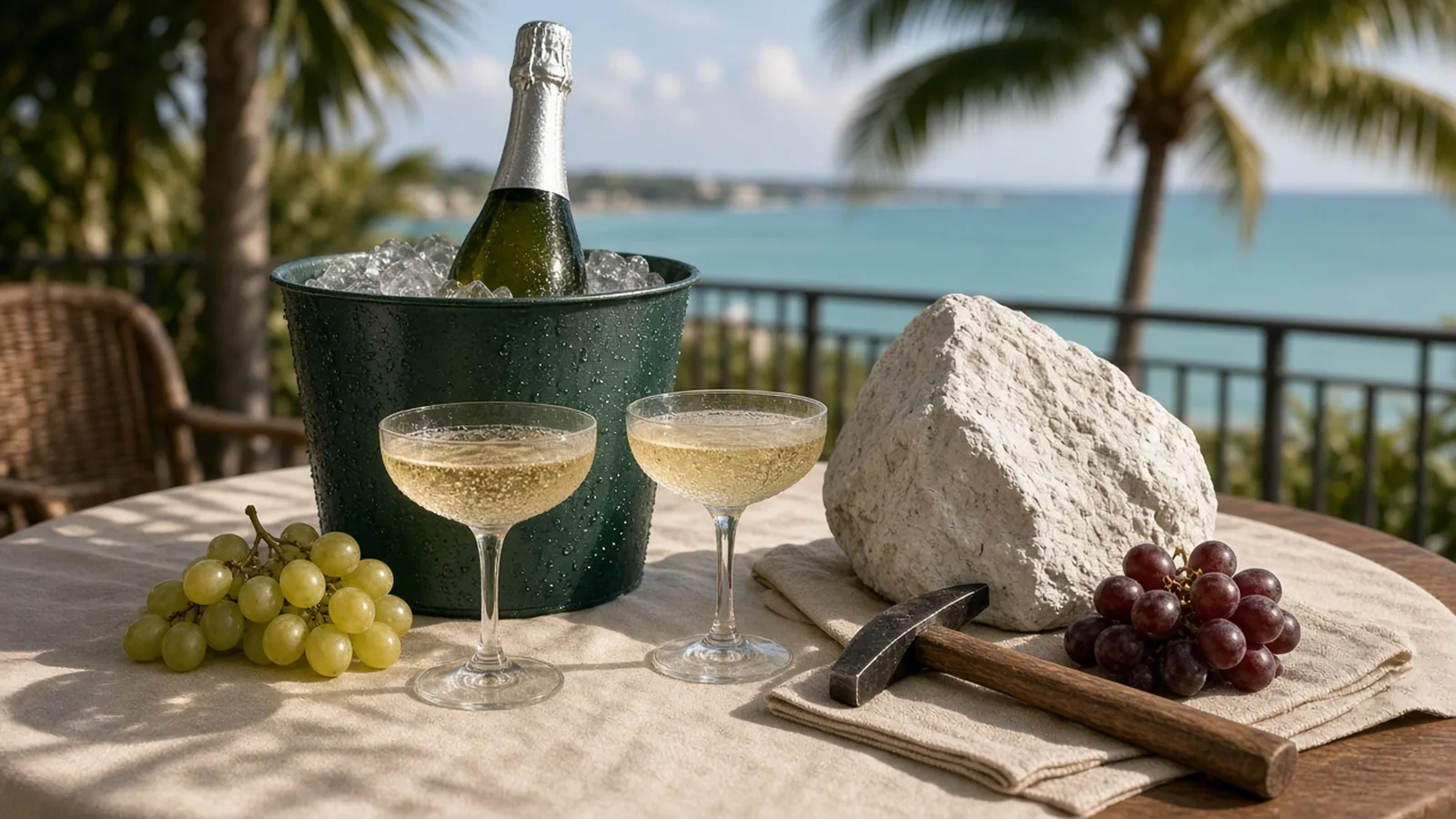
Champagne Is a Rock Story With Bubbles. I Can Prove It.
Seven grapes are allowed, three do almost all the work, and the whole thing sits on a giant underground sponge made of ancient sea creatures. Here's how a bottle of Champagne actually gets made, from the chalk to the cork.

I'm filling in on wine while Kevin is in the Douro Valley, and I have news for everyone who bought a bottle "for the holidays" and then drank it on a Tuesday: you were drinking a rock.
Mostly. Let me explain.
Seven grapes are allowed. Three do the heavy lifting.
Per the Comité Champagne, almost all Champagne comes from three grapes:
Pinot Noir covers 38% of the vineyards. It's the dominant grape in the Montagne de Reims and the Côte des Bar, and it brings body, structure and red-fruit aromas. Yes, a red grape. The juice is pressed gently and fast so it stays pale.
Chardonnay covers 31%. It's the star of the Côte des Blancs, it loves sitting on chalk, and it brings freshness, citrus and flowers. It's also the grape that ages beautifully, which is more than I can say for my patio furniture.
Meunier covers the other 31%. It buds late, so it dodges spring frost, and it handles the clay soils of the Marne Valley. The name means "miller," after the floury white fuzz on its young leaves. It makes the wine round and fruity.
Then there are the quiet cousins. Arbane, Petit Meslier, Pinot Blanc and Pinot Gris are also allowed and together grow on about 0.3% of the vineyard. The Comité says Pinot Gris gets so smoky and nutty that locals nicknamed it "Enfumé." And since 2023 the official appellation rules also allow Voltis, a disease-resistant newcomer capped at 5% of a grower's vines and 10% of any blend.
The chalk is the whole secret
Here's the part I can't stop thinking about. Under the Champagne vineyards is chalk made of fragments of marine micro-organisms laid down millions of years ago. That chalk is so porous it holds 300 to 400 liters of water per cubic meter.
So when it pours, it drains, and the roots stay dry. When it doesn't pour, the chalk feeds water back up to the vines through capillary action. The grapes get just enough stress to ripen with that bright acidity Champagne is famous for. It's a sponge that also knows when you've had enough.
In Florida we call limestone "the reason my sprinkler line cracked." In Champagne they built a world-famous wine on it.
The Côte des Blancs is where this really shows. It's a chalk outcrop planted mostly with Chardonnay, which is why "Blanc de Blancs" (white from whites) bottles taste so crisp and lemony.
They even age it inside the chalk
The chalk didn't stop at farming. In Reims, people quarried it for building stone for centuries, and the old pits, called crayères, became cellars. The UNESCO-listed crayères under Saint-Nicaise Hill are "underground cathedrals," some over 30 meters high. They stay dark, vibration-free, around 11°C and close to 100% humidity, with 57 kilometers of galleries holding tens of millions of bottles.
That's 52 degrees Fahrenheit, year round. I've never been jealous of a bottle before.
Somebody who gets it: Cult Wines International
Kevin sent me this one, and it's the chalk story in one village. Cult Wines International (@cultwinesintl) takes you to Le Mesnil-sur-Oger, a Grand Cru village in the Côte des Blancs that they describe as "sitting on over 100 feet of chalk," and introduces a seventh-generation family making Champagne there. They call it "the greatest Champagne village most people have never heard of," and after watching I want to visit it immediately.
@cultwinesintl The greatest Champagne village most people have never heard of 🥂
How the bubbles get in there
The traditional method, the méthode champenoise, is the most patient recipe I know. Here's the trip, straight from the Comité's making-of guide:
Press. Whole bunches, picked by hand, pressed slowly right after picking. It takes about 1.2 kg of grapes to make one bottle.
First fermentation. The juice ferments into a still, dry base wine. No bubbles yet. Just very tart wine waiting for its moment.
Assemblage. The cellar master blends base wines from different grapes, villages and years, often with reserve wines held back from older harvests. This is how a house tastes the same every year even when the weather doesn't cooperate.
Tirage. The blend goes into heavy bottles with the liqueur de tirage: sugar, yeast and a riddling agent. By rule, this can't happen before January 1 after the harvest.
Second fermentation. In the sealed bottle, the yeast eats the sugar and makes alcohol and carbon dioxide. The gas has nowhere to go, so it dissolves into the wine. That's the prise de mousse, and the bottle ends up at about 6 bar of pressure. That's roughly triple a car tire. Respect the cork.
Aging on lees. The spent yeast (the lees) breaks down in the bottle, a process called autolysis, and gives Champagne those toasty, brioche notes. The rules say at least 15 months before release for non-vintage, including 12 on the lees, and at least three years for vintage. Most houses go longer.
Riddling. The bottles get tilted neck-down and turned a little at a time, by hand or by machine, until all the sediment slides into the neck.
Disgorgement. The neck is plunged into a solution at about -27°C, which freezes the sediment into a plug. Pop the cap and the pressure shoots the plug out. A few large bottles are still disgorged by hand.
Dosage. The bottle is topped up with the liqueur d'expédition, wine and cane sugar. How much sugar goes in decides if it's Brut, Extra Brut or sweeter. Then the cork, the wire cage, and it finally gets to leave.
So the bottle on your table took more than a year, two fermentations and a freezer bath. Take a second before you shake it at a boat party.
The Sarasota part
The holidays are coming, which means New Year's Eve on a lanai in shorts while somebody up north posts a photo of their windshield. That's the right time to pour a Blanc de Blancs, think about a hillside of ancient sea creatures in northern France, and tell the table all of this. They'll love it. Probably.
Planning the rest of the week? Sandy has Coming This Week and the Meetup Picks, so you'll have somewhere to bring the bottle.
Cheers!
— Marina
Still hungry?
Can't pick? Pull a random one From the food, wine and myth-busting pile. No old game slates.